Tuesday, March 25, 2014

RVP (Rural Veterinary Practice)

Last week I finished up another month long rotation. The rotation was RVP or Rural Veterinary Practice which involved going on farm calls! At times I felt like I was in a James Herriot novel as we would go to various farms and treat the animals with supplies from our vehicle like portable ultrasound and x-ray. 


The rotation is split into 1 week each of Farm animal medicine, Equine medicine, and Theriogenology (Animal Reproduction). The fourth week you got to choose an extra week of whatever. I ended up doing 2 weeks of theriogenology mostly because on that service you get to see both large and small animals. For example, in one day I helped breed some dogs, ultrasounded pigs for pregnancy, helped with a C-section on a goat, and performed breeding soundness exams on some bulls. It was a very busy service full of baby animals.
My skin closure on a goat C-section

On Farm Animal week we saw a lot of cattle, sheep, and goats. One day we were at the dairy all day long rectally palpating cows to either determine if they were pregnant or to confirm pregnancy. There were at least 70 cows total that were palpated split between 2 other students and the clinician. Of course the clinician would double check all of the students and I'm sure glad that he did! I've decided that I was not meant to be a dairy cow vet although it was a good experience despite the bruises that I acquired on my left arm. 

On the equine service I got to perform equine dentals which involved using instruments (basically power tools) to smooth and even out the surface of the cheek teeth. I was also able to perform some local nerve blocks and extract some incisors. It was fun doing lameness exams to try to determine where the cause of lameness was arising (hoof vs hock) with gait assessment and nerve blocks. 
Horse dental tools

Overall, I enjoyed the rotation. I learned a lot and enjoyed that this rotation was one of the more hands-on rotations. I got to do a lot of things I will probably never do again in my veterinary career like de-horning, ear tagging, and applying tattoos to cattle. I got to do regional limb perfusion with antibiotics on a goat with a foot infection. I helped collect semen from stallions and bulls for breeding soundness exams. The list goes on but you get the idea. I got to do a lot!
Equipped with my helmet in preparation for collecting semen from a stallion.

Also last week I presented my Senior paper with a powerpoint presentation to my peers and some faculty. It was stressful  but I feel like a did a good job and my mentor Dr. Warnock was very helpful. I presented on orthotic devices in dogs. Now I just have to finish writing the actual paper and turn it in. Once complete, that will be a big weight off my shoulders. 


Lastly, I've officially started my job hunt. I'm mainly looking for a position as a veterinarian in northern Utah so I can be near my family.  So far I haven't had great success but I have had one phone interview and I'm looking forward to a working interview in April. It's hard not knowing exactly what my life will be like or where I'll be after graduation but I'm sure that things will work out and one way or another I will end up exactly where I am supposed to be.


Saturday, March 1, 2014

Large Animal Medicine

I traded in my white coat for my green coveralls during the past 4 weeks for my large animal medicine rotation. Large animal refers to Horses, Cattle, Llamas, Alpacas, Donkeys, Pigs, Sheep, Goats, and Ponies. I saw most of these species on my rotation but some more than others. I was worried about the rotation because I am not as comfortable around these types of animals as I have little background working with them prior to vet school. All of the clinicians and techs were very helpful and understanding and by the end of the rotation I felt more comfortable around these animals. 
Entrance to the Large Animal Hospital

Basically the whole process was similar to what I did on small animal medicine by acquiring a history, doing a physical exam, talking to a clinician about possible diagnostics and treatment options and coming up with a plan. Sometimes the patient was hospitalized for further care or diagnostics. I practiced skills such as drawing blood, giving medications, calculating fluid rates, etc. Different from the small animal side was the number of patients that I had over the four weeks. I only had 7 patients total but that was enough to keep me busy. 
Equine Treatment Area

Also during my rotation we took part in the "Alpacalypse" where approximately 175 alpacas which were seized by the state arrived in Corvallis. Some required medical attention as most of them were malnourished. The medicine students played a big role in caring for the hospitalized alpacas. We also learned how to wrangle alpacas out in the field to do brief physical exams, vaccinate, determine their body condition, listen for heart murmurs, and check for pregnancy by balloting their belly. It was a long process but I felt like I'd accomplished something when we were through. I got to castrate an alpaca, trim toe nails, and trim long incisors. It was a good learning experience and the baby alpacas, or crias were also very cute.Several news crews came through the hospital and I was in the background of several news reports.
Equine Row - where hospitalized horses are kept

In addition to the alpacalypse, this rotation was unique because we had another big snow storm that caused the school to shut down for 2 days. With patients still in the hospital and needing care we still came in for shifts to help care for them. The driving conditions were not ideal and I'm sure glad that my car has 4 wheel drive. The hours on this rotation were long, ranging from 50-73 hours/week. I was fortunate to never be called in while I was on call. 
Horse halters and lead ropes


I was able to do some cool things on this rotation such as belly taps, place IV jugular catheters, thoracocentesis (chest tap) on a horse to drain 9 L of fluid, ultrasound pregnant alpacas, bottle feed a baby alpaca, milk an alpaca, frolic with a 1 week old foal, and the list goes on. One thing about this rotation  for me was it helped solidify that I just want to be a small animal veterinarian. I did enjoy the experience however and I'm glad that I'm more comfortable around large animals now. 
The medicine crew after wrangling alpacas - Alison, Dr. Cebra, Jenni, Me, Kim, Robyn, & Lance

Currently I'm one week into the next rotation, RVP (Rural Veterinary Practice). This rotation consists of 1 week of theriogenology (reproduction), equine practice, food animal practice, and an extra week of one of the above. More info to come in my next post. 

The OSU resident cows C-cow and E-cow

Sunday, January 26, 2014

Back to OHS


The past two weeks were spent back at the Oregon Humane Society(OHS) in Portland. I loved it so much the first time that I decided to go back for more fun and for some preceptorship credit. I was able to work on my skills in surgery (spays and neuters), dentistry, and medicine. I really enjoyed my time there once again.  Everything I did there is very applicable to what I will be doing when I graduate (which is in less than 5 months!).

I had several patients while at OHS and learned something from each of them. The doctors and technicians were great. All were very willing to teach and help out. I enjoyed the company of the other students ( Carissa, Nina, & Kat) and Dr. Funes a medicine intern. I thought it was a great group and we had a lot of fun. The drive to Voo Doo donuts was an adventure that I will never forget! I meant to get a group picture but it didn't happen. ):


I got to have a dog for a night on Friday. Lavinia, my patient for the entire two weeks at OHS has a radius ulna fracture that isn't healing properly and thus requires surgical intervention that can be provided at the OSU vet school. I brought her along, somewhat reluctantly to stay the night with me and then be dropped off at the school the following morning. I say reluctantly because she is a little dog that likes to bark and is not quite potty trained. However, having her with me for one night turned out to be really enjoyable. She did bark a little bit but she had no accidents and it was neat to see her away from the kennel environment. She was so playful and loved to snuggle up next to me while I watched TV. It made me miss having my dog Scout here with me and was a nice reminder of what is waiting for me after graduation.
Lavinia
On a different note. I passed the NAVLE!! Yay! I am one step closer to becoming a DVM. Now all that stands in my way are a few more rotations, my Senior paper and presentation, and graduation. I also will begin searching for a job back in Utah somewhere. 
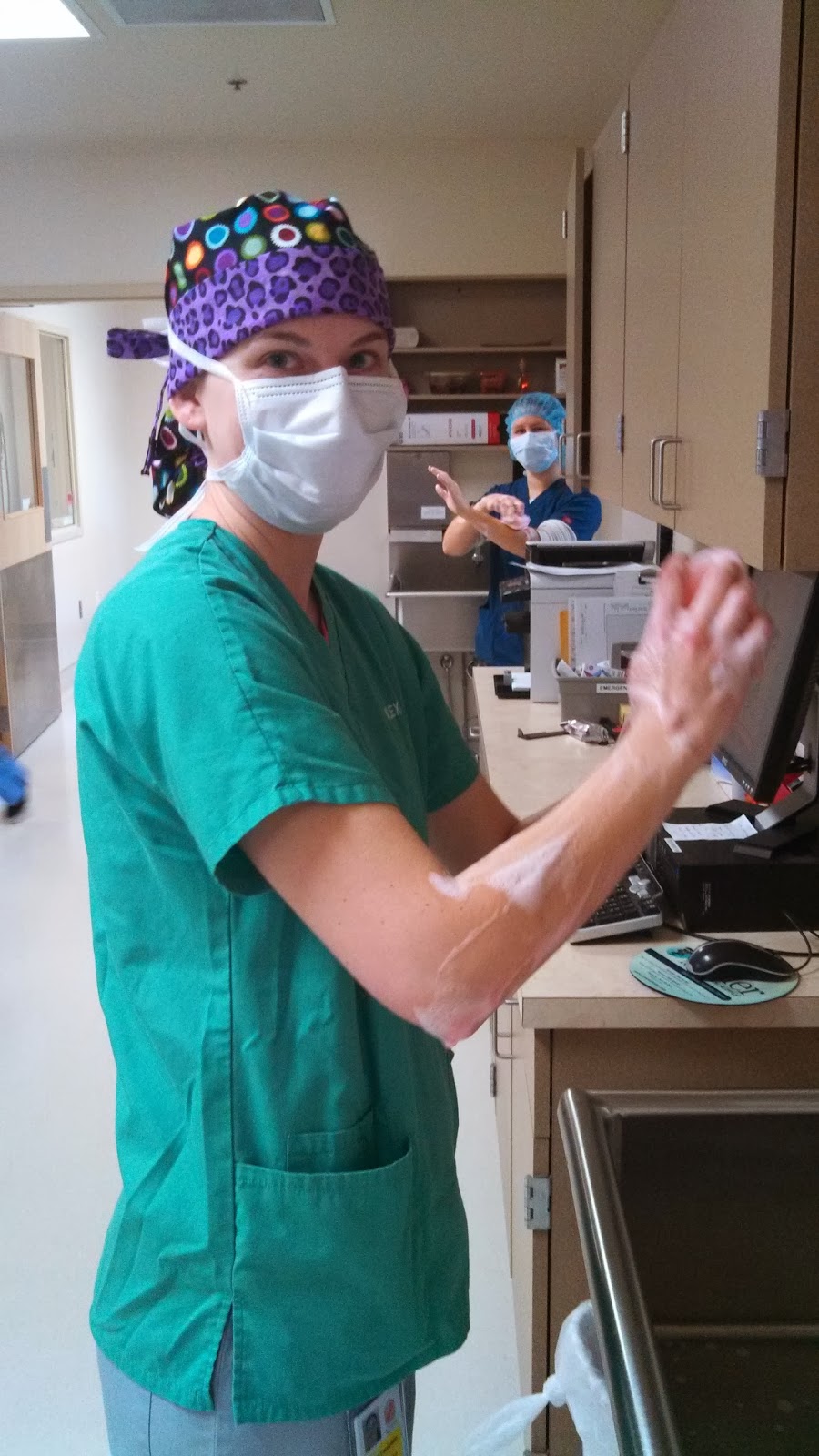
Scrubbing in for surgery on the last day = 5 cat spays, 1 rabbit neuter, 1 dog spay (photo courtesy Carissa Jones)

This week I start my first large animal rotation which will last for 4 weeks. I will be hanging up my white coat for a while and putting on my green coveralls to work with horses, cattle, sheep, goats, pigs, etc. I'm a bit nervous because large animals are not my forte but I'm sure I will learn a lot.


A friend in the student lounge.


Saturday, January 18, 2014

Cardiology


I was lucky enough to have two weeks off over Christmas and my birthday and I went home to Utah to spend time with my family. It was fabulous and as always, hard to come back to school. Fortunately I got to ease back into my clinical rotations with cardiology, a two week rotation. There were three other students on this rotation with me and it was great! (Usually there are only 2 students) The first week was a little slow because of the New Year's holiday but we enjoyed being done early in the afternoon and having New Year's Day off. 
Echocardiogram machine and table

On this rotation I got more confident at hearing heart murmurs and classifying them. I also feel more confident about reading ECG's and treating various arrhythmias. I enjoyed watching echocardiograms on dogs and cats and thought it was fun when we were allowed to try our hand at  it ourselves. It's pretty cool to use the ultrasound probe and be able to see the heart beating and identify all of its chambers and great vessels. All of the techs, residents, and cardiologists were great and very committed to helping the students learn. 


We were lucky to watch a balloon valvuloplasty procedure where they insert a balloon through the jugular vein and into the heart and inflate it over a narrowed portion of the heart valve to try to open the valve up for better blood flow. The dog is under general anesthesia and they use fluoroscopy (real time x-ray) to visualize what they are doing. 
A ECG strip showing 2nd degree heart block

A chart to help identify heart structures on echo
We saw quite a few dogs come in with pericardial effusion (fluid build up in the sac around the heart) and it was neat to see how it looked on ultrasound and how the fluid is removed using a catheter and syringe. This is something I will see in general practice so it was good to have exposure to it now. 


I enjoyed this rotation a lot and feel like I learned a lot. 

Me practicing echo technique on a techs dog.


Currently I'm in the middle of my second rotation at Oregon Humane Society (OHS). I decided to go back for two more weeks of preceptorship credit. I'm loving it! Cute pictures to come in my next update!

Still waiting on the results from the NAVLE. Hopefully I'll be able to say that I passed it in my next update. Fingers crossed!